

Elevated rates in 2026 can make buying feel harder than it needs to. Sitting out is not free either. Rent does not build equity, and prices do not pause while you wait. Homeownership is still how most families build wealth. Here are five ways buyers in Northeast Florida are making the payment work.
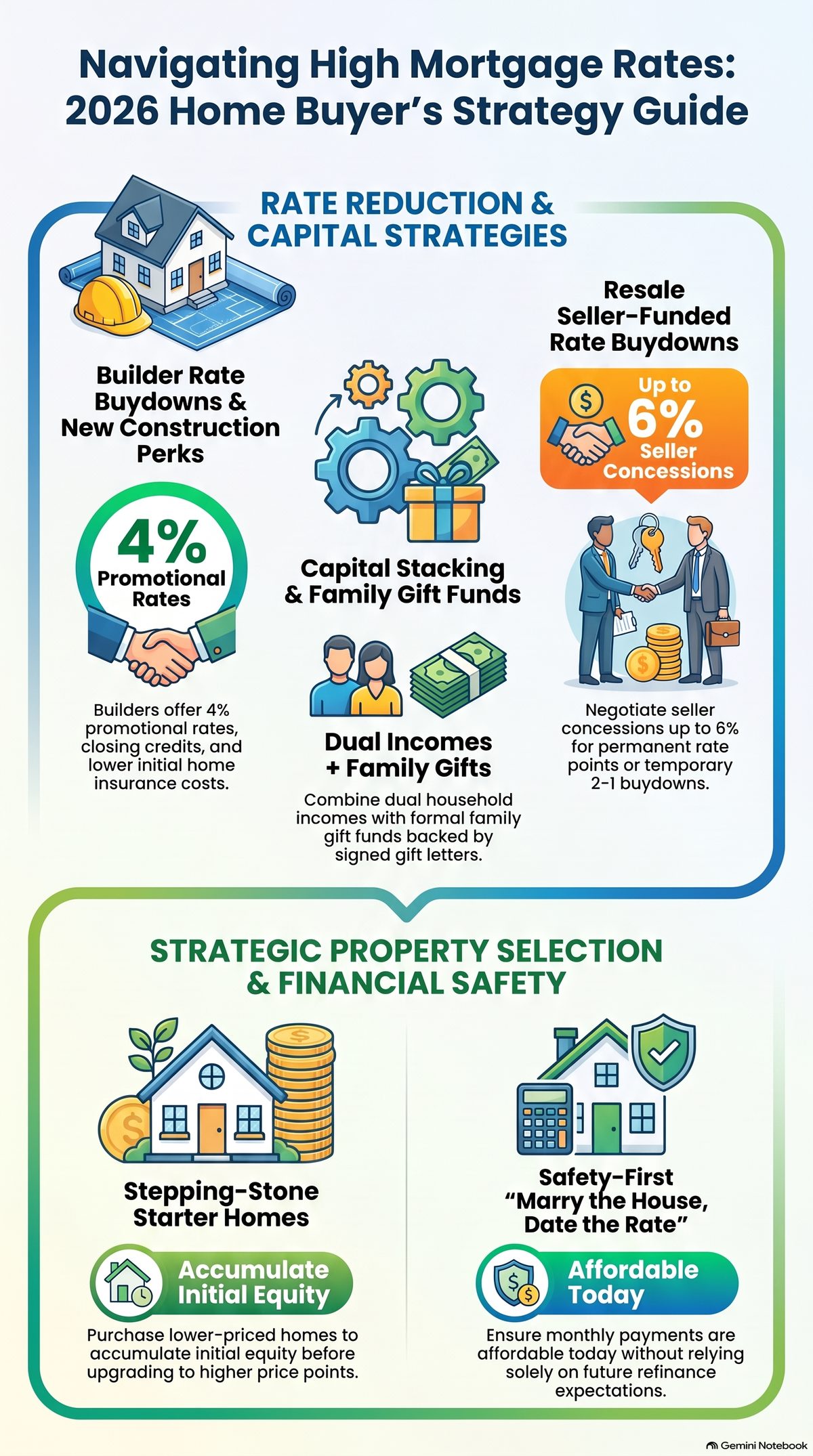
1. Use builder rate buydowns and closing credits
Large builders can offer promotional rates, sometimes in the 4% to 4.5% range, and help with closing costs. They do this without cutting the list price. National builders often lock rates in bulk. Smaller builders usually offer a credit, which helps, but rarely gets a market rate in the 7s down as far.
On many conventional loans with more than 10% down, and on FHA, a builder can contribute up to 6% of the price toward your costs. The strongest deals are often on finished, move-in-ready homes they want off the books.
A rough comparison: a $400,000 new home at a 5% promo rate versus the same price at 7.375% can be more than $700 a month in principal and interest. New construction insurance is often lower too. We run the real numbers on the specific community before you fall in love with the rate.
2. Ask the resale seller to buy down the rate
On a pre-owned home, a seller credit that buys down your rate usually helps your monthly payment more than the same dollars off the price. Sellers can often contribute up to 6% on conventional and FHA loans.
A $20,000 price cut on a $540,000 home might save about $100 a month. The same $20,000 used to buy the rate down about 1% can save closer to $350 a month. Permanent points last for the life of the loan. A 2-1 buydown drops the rate 2% in year one and 1% in year two, then returns to the note rate. Lenders still qualify you at the full rate, which is the safer way to look at it.
3. Start with a home you can actually carry
A starter around $400,000 gets you in and building equity. Waiting for the dream house keeps you renting.
Example over five years: buy at $400,000 with 5% down. The loan starts near $380,000. After five years of payments it is closer to $358,000. At 4% annual appreciation the home is worth about $487,000. After selling costs, you could walk with roughly $95,000. That is a real down payment on the next house. Equity does not start until you own something.
4. Stack income, gifts, and a clean debt picture
Two incomes change the math. Lenders also count car loans, student loans, and other debts in your debt-to-income ratio. Fannie Mae’s automated systems generally cap total monthly debt at 50% of gross income.
About 1 in 5 first-time buyers use a family gift for the down payment or closing costs. The lender needs a signed gift letter and a clear trail from the giver’s account to yours. Do that early so it does not stall the loan.
5. Marry the house. Do not bet the payment on a future refinance
“Date the rate” is fine as a bonus. It is a bad plan if the payment only works after rates drop. Buy what is comfortable at today’s rate. A refinance costs money, needs a new approval, and needs an appraisal. If values soften, you may not be able to refinance at all. A future rate drop should be a win, not a rescue.
Before you browse
Online payment calculators often assume 20% down and average taxes. That number is not your payment. Get a real pre-approval, then we can compare builder promos, seller credits, and the neighborhoods that fit.
If you want this run for your price range in Duval, Clay, St. Johns, or Nassau, reach out or call or text (904) 944-9964.